










Rock stripping and coal handling are both common heavy-duty dozer operations, but the material characteristics differ greatly. Rock has large lump size and strong abrasiveness, so the blade must be able to penetrate and withstand impact; coal is loose and piled in large volumes, so the operation focuses more on single-pass pushing volume and stockyard leveling efficiency. If procurement selects only by power and tonnage, it is easy to overlook configuration differences in the blade, undercarriage, and traction structure.
Below, using the public information of a 320 hp crawler dozer as an example, the decision sequence and corresponding configurations for these two working conditions are explained clearly. The parameters involved in this article all come from the materials for the standard, coal, and rock versions of this model; configurations and performance not listed are not inferred.
First distinguish the goals of the two types of work
The goal of rock stripping is to push and clear weathered rock, stony soil, or crushed stone from its original or piled state. During operation, the blade frequently contacts hard materials, and both abrasion and impact are obvious. The goal of coal handling is to complete pushing, stacking, and site leveling at power plants, ports, or bulk material stockyards. The material is loose but the volume is large, and the blade needs greater holding space and a smooth discharge shape.
The requirements of these two goals for equipment do not fully overlap. The former focuses more on the blade's penetration ability, structural rigidity, and wear resistance; the latter focuses more on blade capacity, pushing process, and stockyard passability. The same base model covers these two scenarios through different versions, which creates the configuration differences between the rock and coal versions.
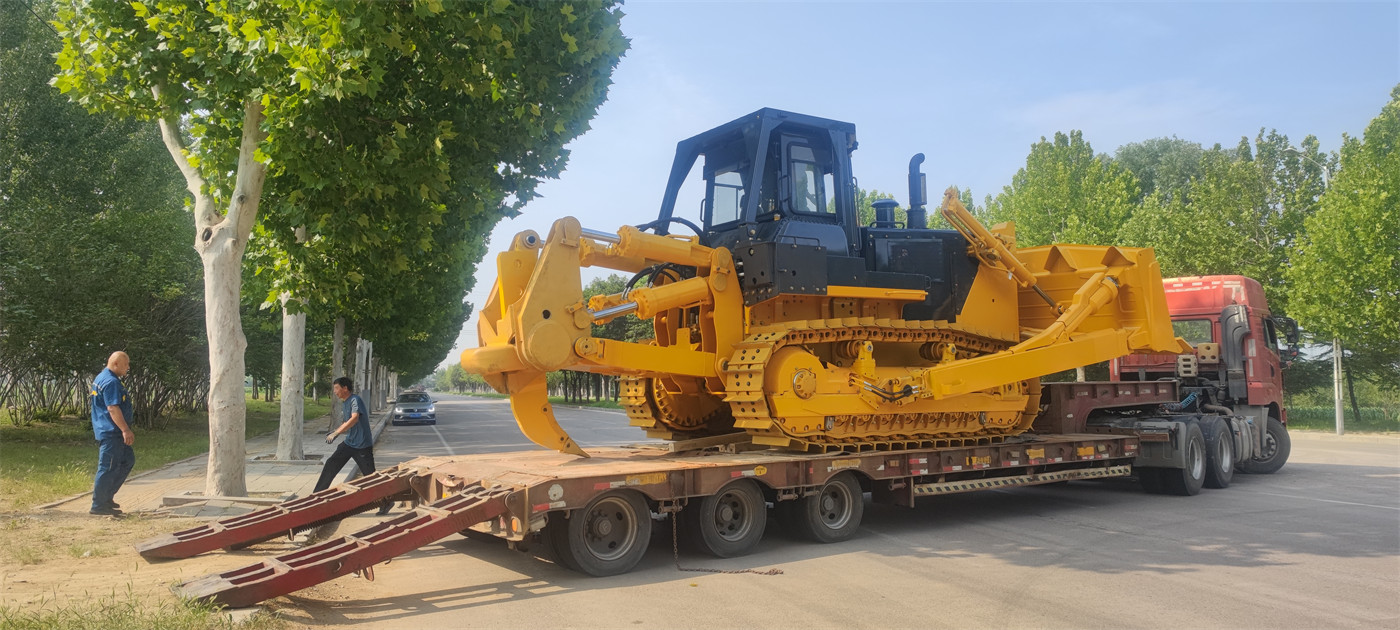
Blade differences: structural shape and wear parts
Rock version: thickened blade and reinforced push arms
The rock version of this model is equipped with thickened high-wear-resistant rock pushing blades and reinforced push arm assemblies. The materials position it for crushed stone quarry extraction, weathered rock stripping, stony soil excavation, and heavy-duty crushing construction in mountainous areas. Blade types include rock straight, rock angle, and rock semi-U, with corresponding widths of 4130 mm, 5000 mm, and 4130 mm, and heights of 1590 mm, 1140 mm, and 1710 mm.
The cutting edge direction of straight and angle blades is more concentrated, suitable for stripping hard materials from their original state; the semi-U type is larger in blade height, suitable for concentrated pushing of already loosened materials. How to choose among the three blades depends on whether the site requires "breaking first" or "breaking while gathering," not on which set of parameters is larger.
Coal version: large-capacity coal blade and stockyard structure
The coal version of this model comes standard with 610 mm wide wear-resistant tracks and an extra-large-capacity coal pushing blade, and adopts a high-strength box-type body structure made of high-toughness materials. The materials position it for stacking, pushing, and leveling operations at power plants, ports, and bulk material stockyards. The coal version offers two types: semi-U coal blades and U coal blades, with widths of 4806 mm and 4520 mm respectively, and both heights of 1710 mm.
The side plate shape of the U and semi-U coal blades helps reduce lateral spillage when pushing loose materials, bringing more coal to the target position. Here, "large capacity" is a qualitative description of the coal version blade in the materials; the specific capacity values are not listed in the materials and should be requested from the supplier during procurement.
| Configuration item | Rock version (SD32W) | Coal version (SD32C) |
|---|---|---|
| Blade type | Rock straight/angle/semi-U | Semi-U coal blade/U coal blade |
| Blade width | 4130/5000/4130 mm | 4806/4520 mm |
| Blade height | 1590/1140/1710 mm | 1710 mm |
| Operating weight | 40900 kg (with single-shank ripper and ROPS) | 40500 kg (with single-shank ripper and ROPS) |
| Ground pressure | 99.4 kPa | 98.4 kPa |
As can be seen from the table, the differences between the two versions are not only in the blade names; blade width, height, and overall machine weight also change accordingly. However, the values in the table are only configuration facts listed in the materials and cannot be directly converted into capacity or efficiency differences.
Corresponding changes in undercarriage and traction configuration
The rock and coal versions share the base undercarriage of this model: track shoe widths are available in 560, 610, 660, and 710 mm, the track gauge is 2140 mm, and the ground contact length is 3150 mm. The coal version materials explicitly state that 610 mm wide wear-resistant tracks are standard; the rock version materials do not list the specific standard track shoe width, so this point should be confirmed during procurement.
Regarding the traction structure, the standard version materials note that a towing device is optional, while the coal version materials mark "no traction structure." If the coal handling site requires towing other equipment or dragging material piles, it should first be confirmed whether this version can be fitted with a traction structure, rather than assuming it has one.
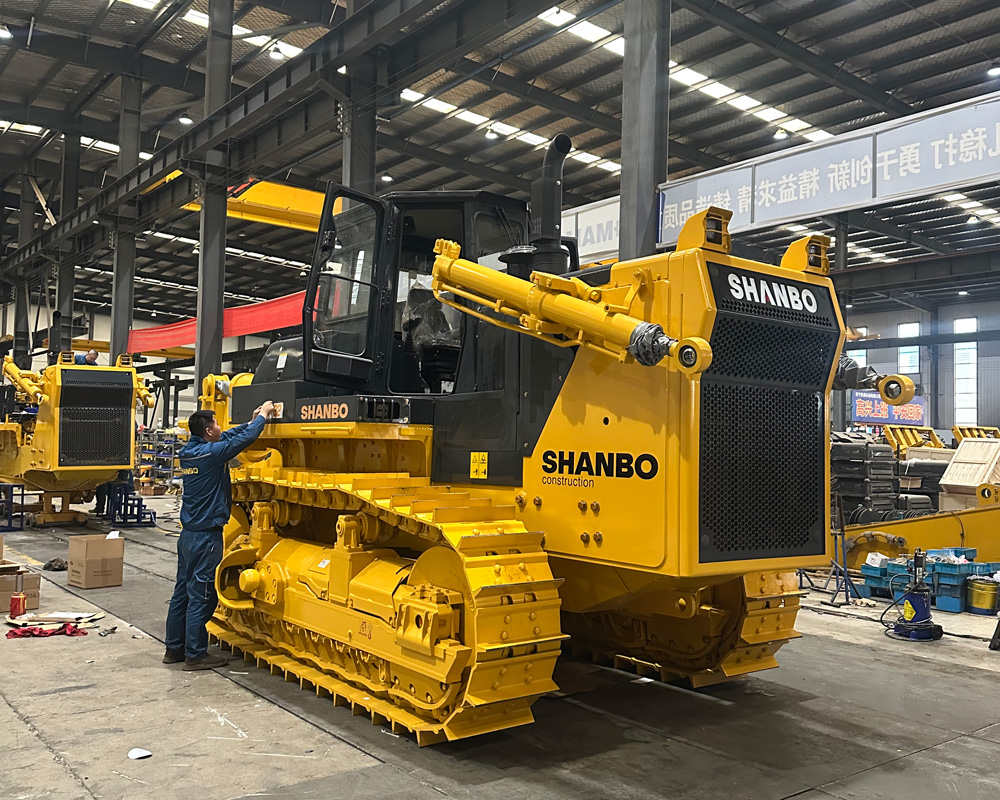
Both versions can be optionally equipped with a single-shank or three-shank ripper. The maximum ripping depth of the single shank is 1250 mm, and that of the three shanks is 842 mm. The ripper is an optional work attachment and is not standard on all delivered configurations; it should be specified in the contract.
Conditions to confirm before procurement
- Material composition: Whether it is weathered rock, stony soil, or loose coal; lump size and abrasiveness determine the blade form and wear part grade.
- Process sequence: Whether stripping comes before gathering, or pushing and stacking are done simultaneously, determines whether to choose straight, angle, semi-U, or U type.
- Whether the blade is standard: The materials list optional blade types; which one is actually delivered must be agreed in the contract.
- Traction requirements: The coal version materials mark no traction structure; if towing work is required, confirm the installation plan with the supplier.
- Ripper configuration: Single-shank or three-shank is selected according to rock formation conditions and is an optional item.
- Track shoe width: The standard width for the rock version is not listed and should be confirmed according to site bearing capacity and wear conditions.
- Emissions and certification: The materials note China III emissions; if the project location has stricter access requirements, compliance documents must be confirmed separately.
Maintenance and application boundaries
The materials for this model mention key structural parts, wiring harness protection, and centrally externally arranged lubrication maintenance points; these designs facilitate daily inspection. Under rock working conditions, the blade cutting edge and push arms wear relatively quickly; under coal working conditions, more attention is paid to the passability of the blade and tracks in bulk materials. Daily inspection should be carried out according to the manual; the materials do not provide specific maintenance intervals or repair values, and this article does not infer them.
It should be noted that this model also has standard and desert versions, each aimed at different scenarios. This article only discusses the differences between the rock and coal versions in blade and traction configuration; other versions are not covered here, and the configuration of one version is not extended to the entire series. The final selection should be judged based on site materials, process organization, and the delivery configuration confirmed in writing by the supplier.